
Interior Designer vs Contractor in Singapore: Which to Hire

An interior designer plans your home and takes responsibility for the outcome; a renovation contractor builds what someone else has already decided. Going direct to a contractor usually saves 10–20% because you're not paying for design time. What you take on instead is every decision, every trade sequence, and every mistake. That trade is worth it for some homeowners and expensive for others, and which one you are has almost nothing to do with your budget.
We've been on the design-and-build side of this since 2011, so treat what follows as a partial view — but a candid one. There are briefs we tell people to take to a contractor.
What's the actual difference between an interior designer and a contractor?
A designer produces the plan — layout, carpentry drawings, electrical positions, materials, lighting — then manages the trades that execute it. A contractor executes a scope you hand them. Both can be perfectly good at their job. The gap is who does the thinking and who carries the risk when something on site doesn't match the drawing.
In practice the roles blur. Plenty of Singapore contractors will sketch a layout for you. Plenty of ID firms subcontract every trade and never touch a tool. The label matters less than two questions: who is accountable for the design decisions, and who is accountable when the tiler and the carpenter disagree about a 15mm gap.
| Direct contractor | Interior designer | Design-and-build firm | |
|---|---|---|---|
| You supply | Layout, material choices, decisions | A brief and a budget | A brief and a budget |
| Drawings | Basic or none | Full set incl. carpentry and M&E | Full set |
| Who coordinates trades | Usually you | Project lead | Project lead, in-house |
| Typical cost position | Baseline | 10–20% above baseline | 10–20% above baseline |
| Single point of blame | No | Depends on the contract | Yes — one contract |
| Best for | Clear vision, simple scope, time to manage | Complex layouts, resale flats, no time | Structural or permit-heavy work |
Which one is cheaper?
A contractor is cheaper on the quotation. Whether it's cheaper at handover depends on how many variation orders your renovation collects along the way. On a full HDB job we quote between $28,000 and $80,000 depending on flat type and how much hacking is involved — the design content of that is real work, and stripping it out genuinely does save money.
Where the saving evaporates is rework. A kitchen carcass built 40mm too deep for the fridge you hadn't bought yet. Power points positioned before anyone knew where the study desk was going. Tiles ordered by the wrong square-metre count. None of these are exotic; they're the ordinary consequence of decisions made in the wrong order, and every one of them is billable.
So the honest framing is: with a contractor you're buying labour and materials. With a designer you're buying labour, materials, and someone whose job is to make the sequence come out right. If your renovation is genuinely simple, the second thing is worth less to you.
When does hiring a contractor directly make more sense?
Go direct when the scope is small, the layout isn't changing, and you already know what you want down to the finish. Concretely, that's a BTO where you're keeping the developer layout, doing flooring, painting, a handful of carpentry runs and lights — and you have the evenings free to answer questions from site.
- You're not moving walls. No hacking means no permit complexity and far fewer sequencing traps.
- Your carpentry list is short. Two wardrobes and a kitchen is a scope you can specify yourself. Fifteen runs of built-ins across four rooms is not.
- You can be reached during working hours. Site questions don't wait politely until 7pm.
- You've done this before. Second-timers know what they didn't know the first time.
One caveat that isn't optional: whoever you engage for an HDB flat must be listed in HDB's Directory of Renovation Contractors. Only DRC-registered firms may legally carry out renovation work in a flat, and an unregistered one can cost you a rejected permit and a reinstatement order. Our HDB renovation permit guide covers which works need approval before anyone starts hacking.
When is an interior designer worth the premium?
When the layout has to change, when the flat is old, or when you can't be the one making forty decisions a week. Resale flats are the clearest case — you're designing around plumbing you can't see, wiring that predates the current code, and floor levels that were never quite level.
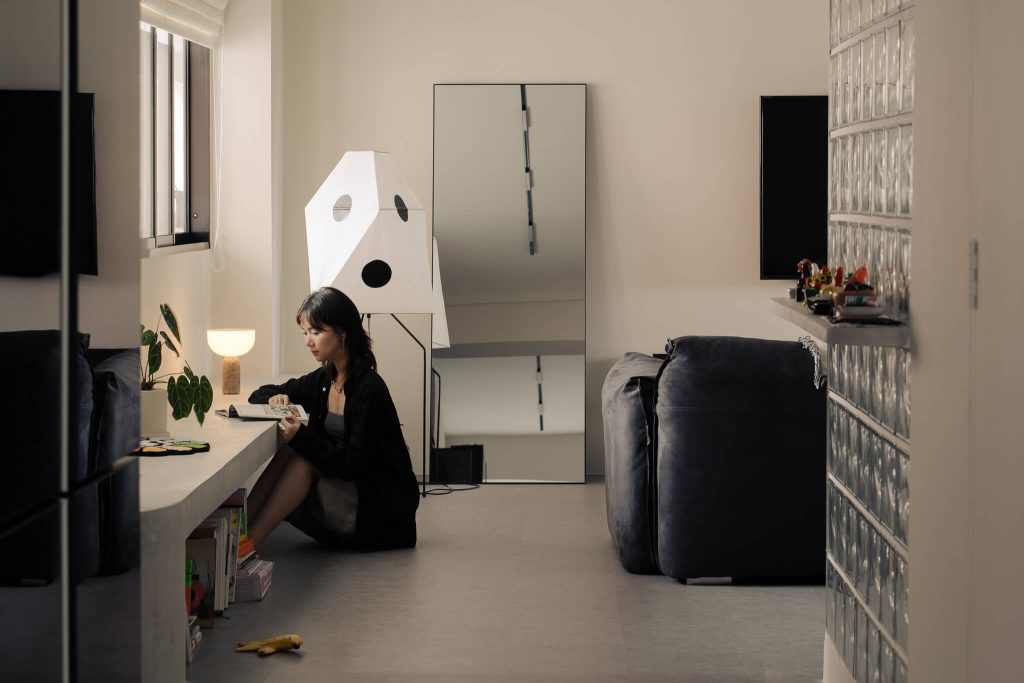
Our resale flat in Tampines is a fair example: raw concrete-finish walls and industrial detailing that read as effortless in photos, and only work because the surfaces underneath were assessed, prepped and sequenced before anything decorative went up. That's not a scope you can write on a WhatsApp thread.
The other case is time. Design development takes four to six weeks done properly, permits another one to three, and site runs eight to ten weeks for an HDB flat. Someone has to hold that calendar together. If that person is you, and you're also working full time, the premium is buying back your evenings.
Is design-and-build a third option?
Yes, and for permit-heavy or structural work it's usually the least risky of the three. A design-and-build firm carries both the drawings and the construction under one contract, which removes the argument that starts every difficult renovation: the designer says the contractor built it wrong, the contractor says the drawing was wrong, and you're standing between them holding the invoice.
It matters most where approvals and structure are involved — landed A&A works, condo units with MCST submissions, anything touching a load-bearing element. For those, look for a firm that's actually licensed to build, not one that subcontracts and hopes. Our HDB interior design service and the landed side both run on this model for exactly that reason.
How do you check either one is legitimate?
Three checks, none of which take more than ten minutes: HDB registration, CaseTrust accreditation, and the contract itself. Renovation contractors were among the top five industries for consumer complaints logged by the Consumers Association of Singapore in 2025, out of 13,786 complaints overall — and prepayment loss is the recurring theme.
- HDB DRC listing — search the firm's name in the directory. Not the salesperson's name, the company's.
- CaseTrust accreditation — accredited renovation businesses must use a standard contract, cap the initial deposit at 20%, pay progressively against milestones, carry a 12-month workmanship warranty, and protect your deposit with a performance bond. CASE publishes the full criteria.
- The written contract — a real one, with a payment schedule tied to stages and a defects rectification clause. If a firm resists putting the schedule in writing, that is the answer to your question. Our guide to a normal renovation payment schedule sets out the stages to expect.
What should you ask before signing either one?
Ask what isn't in the quote. The gap between two quotations is almost never the same work at different prices — it's different work at similar prices. Learning to read the line items is the single highest-value hour a first-time homeowner can spend.
- How many electrical points are included, and what does an additional one cost?
- Is hacking debris disposal in the price, or a provisional sum?
- Which items are “subject to site condition” — and what happens to the price when the site disagrees?
- Who submits the permit, and is the fee included?
- What's the payment schedule, and what triggers each stage?
- Who exactly will run my site, and how many other jobs are they running that month?
If you want a benchmark before you start comparing, our BTO renovation cost breakdown sets out what the individual trades should come to. And if you'd rather see who you'd actually be working with, our designers each have a profile with the homes they've completed.
The bottom line
Simple scope, clear vision, spare time — a good contractor will serve you well and cost you less. Changing layouts, an older flat, or a schedule that's already full — the design fee buys coordination you'd otherwise be doing badly at midnight. What you shouldn't do is pick on price alone, because the cheapest quotation and the final invoice are frequently two different numbers.
Ready to design your home?
Our design team will get back to you within 24 hours with a tailored proposal.